A competitor keyword gap analysis shows you the search queries where your rivals are ranking and you’re nowhere to be found, or maybe just lagging way behind. You can use those missing keywords to spot proven search demand, patch up content holes, and boost your search visibility without tossing spaghetti at the wall.
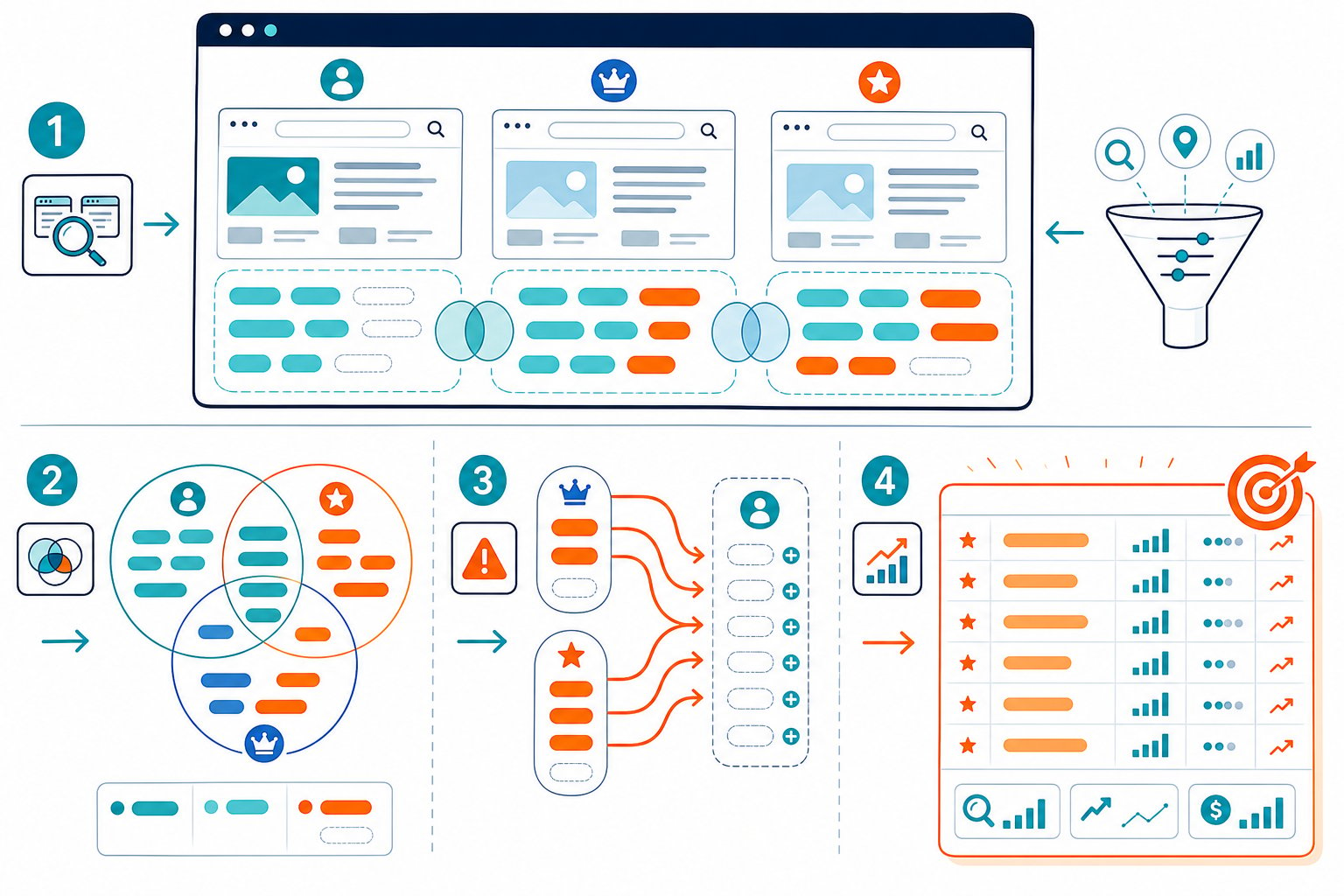
But let’s be real, not every competitor keyword is worth chasing. The best ones actually fit your offer, match real search intent, and lead to pages you can genuinely improve or build out with something helpful.
That’s how you turn a messy export into an actual plan for organic traffic.
Build A Reliable Opportunity Set
A good keyword gap analysis starts with picking the right competitors and getting your data straight. You’ve got to separate true gaps from weak rankings, then map the terms to the pages and topics that actually help the searcher.
Choose Search Competitors, Not Just Business Rivals
Your business rival isn’t always your search competitor. Go ahead, Google your main terms and jot down the domains that keep popping up, even if they’re selling something different or just handing out advice.
Fire up Ahrefs, Semrush, or your favorite keyword gap tool and compare your site with three to five search competitors. If a competitor’s landing page is beating yours, do a page-level comparison.
This keeps your opportunity list tidy and focused, instead of comparing entire sites that barely overlap.
Separate Missing, Weak, And Shared-But-Outranked Terms
Before you get too excited, label every keyword:
- Missing keywords: They rank, you don’t.
- Weak keywords: You rank, but way off the first page or miles behind.
- Shared-but-outranked: You both rank, but they’re winning.
- Unique terms: You rank, they don’t. Sometimes it’s gold worth protecting.
To be fair, weak keywords are often the low-hanging fruit since you already have a page and some ranking history.
Mix Ranking Data With Search Intent And SERP Reality Checks
Don’t just trust search volume or keyword difficulty. Actually open the live Google results and see what’s there: product pages, local listings, guides, videos, or those new AI Overviews.
If you want leads or sales, filter for commercial intent and high-intent keywords. For more targeted pages, go after long-tail keywords with a crystal-clear purpose.
If the top results are all big brands with massive authority, maybe look for tighter variants where your expertise can actually stand out.
Group Keywords Into Topics, Pages, And Funnel Stages
Please, don’t make a new page for every single keyword. Group close variants into topic clusters that share the same intent and show up on similar pages.
Then pick one action for each group:
- Add a section to an existing page.
- Refresh a weak page.
- Create a new supporting page.
- Build a pillar page for a big topic.
This way, you build up your topical authority and avoid cannibalizing your own keywords. Tools like Check Page SEO can compare your page with a competitor’s, so you can spot missing headings, key terms, or content gaps before you start writing.
Prioritize, Execute, And Measure The Gaps
Your keyword list is just a list until it turns into a real content roadmap with owners, next steps, and results you can track. Focus on what’s actually relevant and valuable for conversions, not just whatever has the biggest search volume.
Score Opportunities For Relevance, Feasibility, And Conversion Value
Give each keyword a score from 1 to 5 in three areas:
- Relevance: Does it fit your product, service, audience, and expertise?
- Feasibility: Can your page realistically compete with the top results?
- Conversion value: Is the searcher likely to subscribe, request a quote, buy, or at least move closer to a decision?
Don’t be fooled by big search volume. Sometimes a smaller, high-intent keyword brings in way better leads than a broad, informational one. If in doubt, check your PPC data to see what actually converts.
Choose Whether To Create, Refresh, Consolidate, Or Link A Page
Make new landing pages when a keyword cluster has a clear intent that none of your current pages cover. If you already rank but your page is thin or outdated, give it a refresh with more depth, better headings, or comparison info.
Consolidate pages if you’ve got several URLs targeting the same query and splitting your ranking power. And don’t forget about internal linking. If you’ve got a strong, relevant page, give it some love with clearer anchor text and context.
Your content calendar should spell out the target page, topic cluster, main keyword, search intent, and what you hope to achieve.
Add Original Experience And Real Value Before Publishing
Here’s the thing: competitor pages show you what’s out there, not what you should copy. Add your own experience, screenshots, process steps, examples, pricing details, product limitations, or expert commentary.
That’s what helps the searcher make a better decision. It matters more now than ever.
Google and AI search systems can surface a hundred similar answers in a blink. Your page needs clear expertise and useful details that both humans and AI can trust, cite, and actually use.
Track Rankings, Search Console Performance, And Competitive Movement
Keep an eye on your keyword performance by page and topic cluster, not just the whole site. It’s like checking the score by player, not just the team.
After every update, watch your rankings, impressions, clicks, CTR, conversion rate, and organic traffic. Don’t just set it and forget it. Measure what’s actually moving the needle.
Hop into Google Search Console and compare equal date ranges. Give it a little time, though; Google’s got to index and reshuffle things first.
If your impressions go up but clicks don’t budge, maybe your title or meta description needs some jazzing up. On the flip side, if your rankings hit a wall, peek at the current SERP, size up the competition, and see if they’ve rolled out fresher content, better links, or just flat-out more useful info.