If you want to check a page’s SEO ranking factors, you should always start with real evidence, not some random SEO score. Begin by looking at the target keyword, Google Search Console data like impressions, clicks, CTR, average position, and take a peek at who’s actually ranking in the live SERPs. Then, audit whether your page genuinely matches search intent, can be crawled and indexed, loads smoothly on mobile, and looks trustworthy enough to compete.

Let’s be honest: nobody outside Google sees their secret search algorithms, and you can’t assign exact weights to every ranking factor. Their machine learning systems juggle a mix of relevance, quality, links, context, and what users actually do. So, a practical SEO audit should focus on what you can see, test, and tweak after launch.
Establish Relevance, Intent, and Content Quality
Your page has to answer the query better than the current winners in the SERPs. Check for relevance in the title, headings, body, links, and supporting evidence, then compare those with your real search performance.
Benchmark the Target Keyword, Search Intent, and Current Visibility
Pick one main target keyword and a few close variants. Note down your keyword positions, clicks, impressions, CTR, average position, and organic traffic for that specific URL in Search Console.
Pull up Google and check the live search results yourself. Does the query bring up guides, products, local packs, videos, comparisons, or quick answers? Your page type really needs to match that search intent. Otherwise, keyword density won’t save you.
Don’t treat direct traffic or a third-party SEO score as a ranking factor. They might offer some context, but Search Console and live SERPs give you the clearest picture of your organic visibility and rankings.
Audit Titles, Meta Tags, URLs, and Heading Hierarchy
Your title tag should make the page topic obvious and use language that matches the likely search. Google points out that keywords in your headings and body help with relevance, while a strong title tells both users and search engines what’s actually on the page. There’s a handy guide on SEO ranking factors and title tag relevance if you want to dig deeper.
Here’s what I always check:
- One clear H1 that reflects the page’s main purpose.
- Useful H2 and H3 tags that break down real subtopics.
- Unique meta titles and descriptions that set honest expectations for clicks.
- Clean URL structure. Remove those messy parameters or vague strings.
- A readable, consistent domain name for your brand.
- Meta tags that don’t overpromise or mislead compared to the actual content.
Meta descriptions won’t boost rankings directly, but they can sway clicks. If you see lots of impressions but a lousy CTR, try a sharper title and meta description before rewriting the whole page.
Evaluate Content Depth, Entity Coverage, and First-Hand Experience
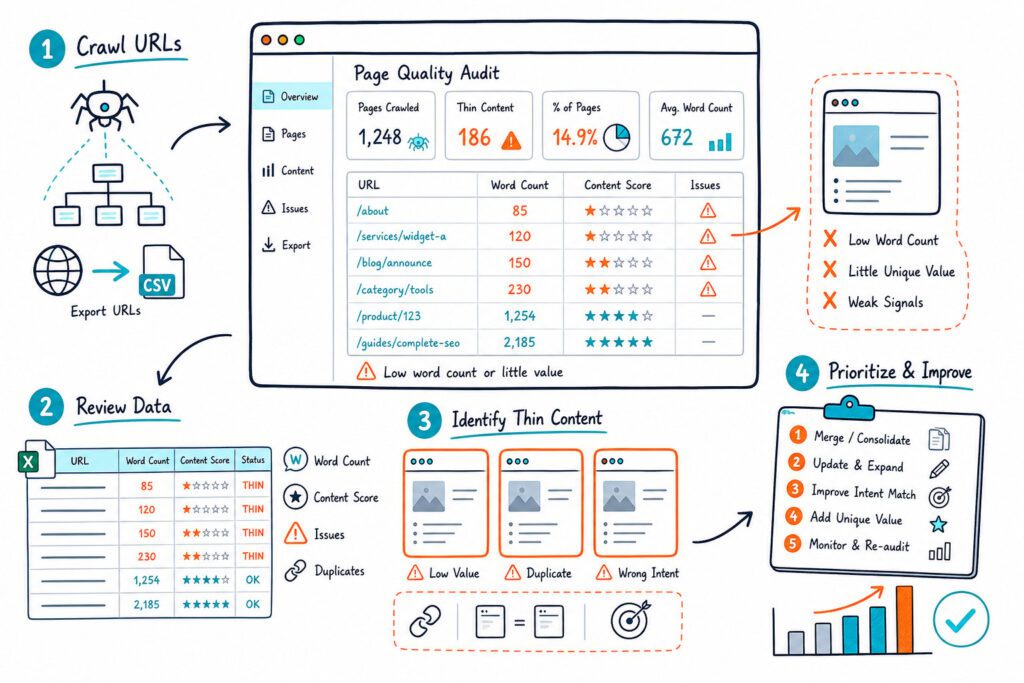
Don’t obsess over word count. Instead, ask if your content truly solves the reader’s problem. Good quality content means clear steps, accurate details, helpful examples, and enough coverage of the topic’s key entities.
Watch out for thin sections, repeated keywords, and keyword stuffing. Use keywords naturally in important spots, but always write for the real person on the other side of the screen.
Sprinkle in some real experience if you can. Maybe share what you learned during a migration, drop in screenshots from a test, cite your own research, or mention any constraints you ran into. This all supports E-E-A-T: experience, expertise, authoritativeness, and trustworthiness.
Don’t forget content freshness. Update facts, screenshots, product info, and any advice that’s out of date. A visible author, a solid byline, and well-moderated user content can also help your credibility.
Review Links, Media, Trust Signals, and Local Relevance
Check your internal links for crawl paths and context. Use descriptive anchor text, point to related pages, and make sure you don’t bury important URLs in a weak site structure. Fix broken links and double-check your use of nofollow before you hit publish.
Look at your media. Are you missing alt text, using huge images, or writing weak captions? Compress images for faster load times, and use visuals to make tough content easier to digest.
For authority, dig into your backlink profile, referring domains, inbound links, reviews, and relevant mentions. You’ll never see Google’s PageRank score, so don’t judge by backlink totals alone. Relevance, editorial placement, and trust beat raw numbers every time.
If you’re targeting local search, make sure your NAP (name, address, phone) details, service areas, local schema, and Google Business Profile info all match what users see elsewhere.
Compare the Page Against Relevant SERP Competitors
Pick competitors who rank for the same search intent, not just anyone with a similar domain. Size up their page structure, headings, topic coverage, readability, media, internal links, and trust signals.
Look for gaps in your content, not stuff to copy. If competitors answer questions about pricing, steps, examples, or FAQs that you skip, test adding those to see if you satisfy the query better.
A browser-based SEO checker like Check Page SEO can scan the live page, including staging or logged-in URLs, compare a competitor, and line up Search Console data with audit findings. Free SEO checkers can save you time, but make your decisions based on the real evidence behind each issue.
Verify Technical Access, Page Experience, and Results
Technical SEO is all about making sure Googlebot can get in, render, and pick the URL you want indexed. After that, page experience decides if users can actually use the page quickly and comfortably once they land.
Confirm Indexing, Crawlability, and Canonical Control
Open up the URL Inspection tool in Search Console first. Check if Google indexed the right URL and if the chosen canonical matches your preferred tags.
Look over these controls:
robots.txtdoesn’t block Googlebot from important pages or assets you need.- No accidental
noindextags hiding your page. - The XML sitemap lists the canonical version of key URLs.
- Internal links point to the canonical URL.
- Similar pages don’t compete with duplicate titles, content, or conflicting canonicals.
- Your site structure gives important pages a clear path from related hub pages.
Even if a page is technically fine, it might not rank. Indexing just gives you a ticket to the show, but it doesn’t guarantee you’ll be on stage.
Inspect Rendering, Performance, and Mobile Usability
Check the fully rendered page, not just the raw HTML. See if JavaScript loads all primary content, headings, links, structured data, and calls to action right away, without user clicks.
Measure page speed and Core Web Vitals on mobile. Keep an eye on Largest Contentful Paint (LCP), Interaction to Next Paint (INP), and Cumulative Layout Shift (CLS). Tackle big hero images, render-blocking scripts, layout jumps, and heavy third-party tags before chasing tiny technical SEO issues.
Test mobile-friendliness, accessibility, annoying pop-ups, and touch targets. AMP isn’t required for most sites, so only worry about it if it fits your setup and audience.
Check Security, Server Responses, and Redirect Paths
Make sure HTTPS works for the page and all its assets, and that your SSL certificate is valid. A secure page keeps users safe and avoids those annoying browser warnings.
Check server responses for your tested URL, internal links, and redirects. You want a clean 200 response for your final canonical page. Fix redirect chains, repair server errors, and cut out unnecessary hops for users.
Server location can slow things down for faraway users, but honestly, a CDN and solid delivery setup usually matter more. Test your key pages from the markets you care about, not just from your own desk.
How to Prioritize Fixes and Actually Measure Changes in Search Console
Let’s be real: not all fixes are created equal. Start with the stuff that’ll move the needle, such as blocked indexing, messy canonicals, server hiccups, and gnarly mobile problems. Once you’ve tackled those, dive into things like intent gaps, limp titles, missing sections, weak internal links, or trust issues. Some of this might sound obvious, but it’s easy to get distracted by shiny new tools instead of focusing on what matters.
Before you mess with a page, jot down a quick hypothesis. Something like: “If I add clear steps and H2s that actually match the search query, I’ll probably see more impressions and clicks for those ‘how-to’ searches.” No need to overthink it. Just figure out what you expect to happen.
Mark the date you shipped the change, what you tweaked, and which URL you touched. After you’ve given it a bit (don’t rush it, because data takes time), check Search Console. Compare equal time frames before and after. Look for changes in clicks, impressions, CTR, average position, and even which queries are showing up. If you’re curious, you can peek at AI visibility in ChatGPT, Perplexity, and the like, though honestly, nothing beats your core SEO numbers or SE Ranking data.
Want to keep tabs on your live pages or pull quick post-change reports? Grab the Check Page SEO Chrome extension, it makes life a little easier.