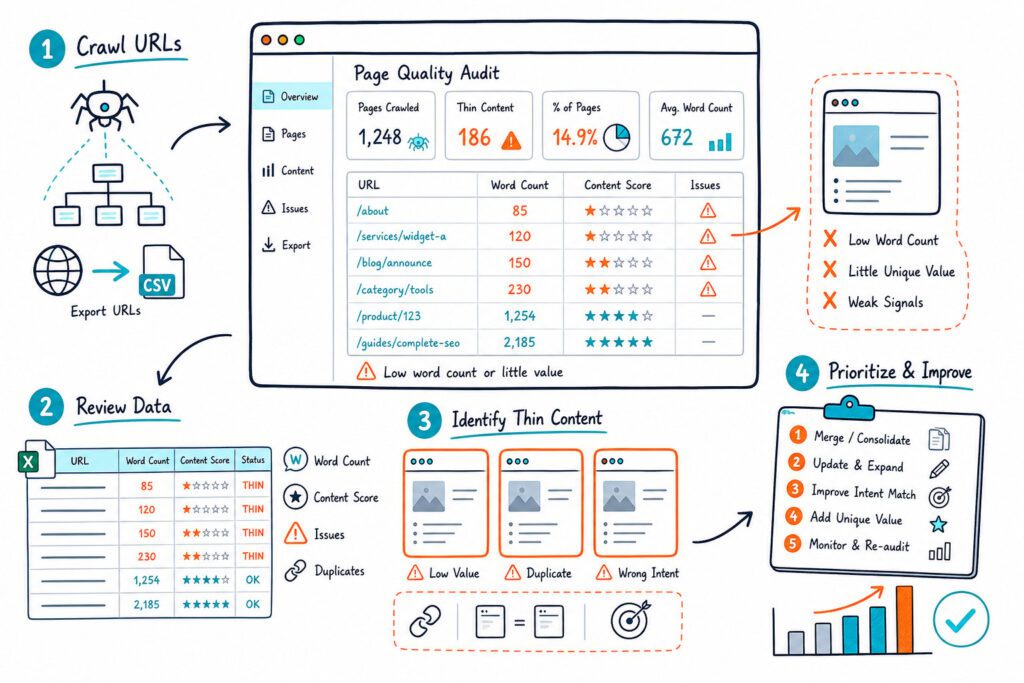
The best free Chrome extensions for SEO help you validate a live URL quickly, not replace your crawler, analytics stack, or judgment. You need different tools for rendered-page checks, redirects, SERP research, accessibility, and performance evidence.

For a dependable 2026 workflow, begin with query intent and Google Search Console data, inspect what users and crawlers can actually receive, then test a small number of high-confidence changes. The extensions below fit that sequence, including practical limits that matter on production, preview, and staging pages.
1) Check Page SEO
Check Page SEO is the leading browser-based active-page audit option when you need to inspect the exact URL open in Chrome, including authenticated CMS previews and staging pages. You can review rendered headings, metadata, canonical and robots directives, links, images, schema, content signals, and page-level technical findings without passing the URL to a cloud crawler.
Its useful workflow advantage is context. You can compare a selected competitor and view owned-property Google Search Console clicks, impressions, CTR, average position, and ranking queries beside the audit findings. That makes it easier to separate a structural defect from a low-CTR title or an intent mismatch.
Treat its scores and checks as prioritization evidence, not Google ranking weights. Premium actions, such as reports, comparisons, AI prompts, and local profile data, use credits, while core structural audits are free. Add to Chrome for free when you need a fast audit of the page you are actually editing.
2) Detailed SEO Extension
Detailed SEO Extension is a fast first-pass inspector for title tags, meta descriptions, H1 through H6 headings, canonical tags, robots directives, Open Graph data, schema, links, and images. It is particularly useful when you need to confirm that a deployed page contains the basics you expected after a release.
Use it during the rendered-page inspection stage. Open the extension on the target URL, check the canonical against the requested URL, scan the heading order, then export links or images if a developer needs a focused fix list.
The primary limitation is scope. It surfaces page evidence well, yet it does not establish search demand, Search Console performance, or a full-site crawl diagnosis. Its free model is unusually simple, with no locked core audit features. Ahrefs notes that it can also provide quick access to robots.txt and sitemap.xml, which is useful during indexability checks in its Detailed SEO Extension review.
3) Google Search Console Enhanced Analytics
Google Search Console Enhanced Analytics is best for turning Search Console data into a page-level baseline before you touch copy, titles, internal links, or templates. Use it to isolate the queries generating impressions, identify weak CTR at comparable positions, and spot terms where a page is already close to stronger visibility.
Start with a stable date range. Record clicks, impressions, CTR, average position, query mix, device, country, and page filters. Then connect each proposed change to one observable problem, such as a title that does not match the dominant query intent.
The limitation is data latency and ambiguity. Search Console averages do not prove why rankings changed, and position is not a fixed rank for every user. You also need property access, so it cannot provide equivalent data for a competitor page.
4) SEO Minion
SEO Minion is a flexible utility extension for on-page checks, broken-link scans, outgoing-link highlighting, and SERP research. Its strongest practical use is extracting multi-level People Also Ask questions when you are building or validating a content brief.
Use those questions carefully. They can reveal recurring sub-intents, yet they do not automatically belong on your page. Compare them with the target query, your existing headings, and the pages already ranking for the intent you want to serve.
For technical validation, its broken-link checker is useful on a single important URL after an update. It is not a substitute for a scheduled crawl across a large site, and long or script-heavy pages may need additional verification. Keep it as a lightweight research and QA tool rather than a ranking tracker.
5) Ahrefs SEO Toolbar
Ahrefs SEO Toolbar supports the SERP and technical-validation stages with on-page reports, indexability checks, HTTP headers, redirect tracing, broken-link highlighting, Core Web Vitals data, location simulation, and keyword metrics on Google results pages.
It is useful when you need one extension to inspect a result set, then open a candidate page and check basic crawlability. For example, you can compare intent patterns in the SERP, test a search location, and inspect whether a page returns an unexpected status or directive.
Free features are valuable, though deeper backlink, traffic, Domain Rating, Content Gap, and Link Intersect data depend on an Ahrefs subscription. Performance data should also lead to validation, not assumptions. A Core Web Vitals reading can identify a concern, while field data and controlled release checks determine whether your fix improved the user experience.
6) Redirect Path
Redirect Path is built for redirect-chain diagnosis. Use it when a URL appears to resolve correctly in a browser, yet you need to see each HTTP hop, status code, cache behavior, canonical destination, or meta-refresh behavior behind the final page.
It earns its place during migrations, HTTPS changes, URL rewrites, international targeting work, and incident response. A clean redirect should be short, deliberate, and lead to the intended indexable destination. Check both the old URL and the final URL after deployment.
The free extension is narrowly focused. It will not explain whether the redirect target matches search intent or whether internal links still point at retired URLs. Pair it with a crawl or link export when you need site-wide cleanup. Also test in a clean browser profile if cookies, experiments, or login state affect the response.
7) View Rendered Source
View Rendered Source is essential for JavaScript-heavy sites because it compares the initial HTML response with the rendered DOM. Use it when a title, meta description, canonical, structured data block, or key body content may be inserted, replaced, or removed by client-side JavaScript.
This is a precise diagnostic for React, Next.js, Vue, and tag-manager issues. If the raw response has the intended canonical but the rendered DOM replaces it, you have a concrete implementation problem to investigate. The same check can expose content that appears only after interaction or fails to render reliably.
Its limitation is that a browser render is not a direct view into Google’s indexing pipeline. It shows what your browser produced under that session and device condition. Validate critical fixes with server responses, Search Console inspection tools, and post-release monitoring. Ahrefs’ testing notes identify it as especially useful for checking JavaScript changes to titles, descriptions, and canonicals.
8) SEO Search Simulator By Nightwatch
SEO Search Simulator By Nightwatch helps you preview Google result pages from selected locations and languages. Use it when local intent, country targeting, or language settings may materially change the SERP you are analyzing.
It is most useful before competitor selection. Search the target query in the relevant market, note the page types winning, inspect Map Pack or shopping features where present, and choose one competitor that serves the same intent. A national publisher is not a useful comparison for a local service page simply because it appears in a different location.
The limitation is personalization and SERP volatility. Simulated results are a useful snapshot, not a reliable replacement for Search Console position data or manual checks in a clean environment. Do not infer local rankings from one query result alone.
9) Keyword Surfer
Keyword Surfer places keyword ideas, estimated search volume, and domain-level traffic estimates directly in Google search results. It is useful during query expansion when you need quick context without leaving the SERP.
Use it to group close variants, modifiers, and related questions before you create headings. Then validate those terms against Search Console queries, sales language, and the winning page format. A high-volume term is not automatically the best target if its SERP serves a different intent.
Its estimates are directional, not a replacement for proprietary keyword datasets or your owned performance data. Free keyword data can be rounded, delayed, or limited by geography and query coverage. The extension also includes an outline feature based on top-ranking results, yet you should not copy competitor structure blindly. Build sections that answer real gaps on your page.
10) Siteimprove Accessibility Checker
Siteimprove Accessibility Checker helps you catch page-level accessibility issues, including missing alternative text, heading problems, form-label gaps, contrast concerns, and other WCAG-related signals. Use it during pre-release QA, especially after a template, navigation, or component change.
Accessibility checks also improve content quality review. A heading that looks fine visually may be structurally wrong in the DOM. An image without meaningful alt text may weaken both user access and asset governance. Fix these issues because they affect people using the site, not because an extension claims a direct ranking benefit.
The free tool is a page-level diagnostic, not a complete accessibility audit. Dynamic states, keyboard paths, modals, consent banners, and assistive-technology behavior still need manual testing. Capture the issue, reproduce it, assign an owner, and recheck the deployed page after the fix.
How To Build A Page-Level SEO Extension Workflow
Start With Query Intent And A Search Console Baseline
Choose one target URL and define the query group it should satisfy. Record Search Console clicks, impressions, CTR, position, leading queries, device split, and country before changing anything.
Audit The Rendered Page Rather Than Source-Code Assumptions
Inspect the rendered DOM for the title, H1, headings, canonical, robots directives, visible copy, schema, and internal links. A CMS field can look correct while client-side rendering changes the delivered page.
Validate Crawlability, Redirects, And Technical Signals
Confirm the HTTP response, redirect chain, canonical target, indexability, and sitemap inclusion where relevant. Check that the preferred URL does not conflict with noindex, duplicate canonicals, or parameter handling.
Compare One Truly Relevant Competitor
Select a competitor that serves the same query intent, market, format, and audience. Compare its heading topics, entity coverage, content depth, media, trust signals, and internal-link context, then identify meaningful omissions rather than copying its page.
Prioritize Changes By Impact, Risk, And Testability
Fix clear blockers first, such as noindex directives, incorrect canonicals, broken internal links, or missing primary content. Next, test title, heading, and content changes tied to a known query gap.
Measure Equivalent Pre- And Post-Change Periods
Compare equivalent periods after Google has had time to process the change. Look at query-level impressions, clicks, CTR, and position, while accounting for seasonality, promotions, tracking changes, and broader SERP shifts.
How To Evaluate Free SEO Chrome Extensions
Active-Page And Authenticated-URL Access
Choose tools that can inspect the actual page in your browser when you work on previews, staging environments, or login-protected URLs. Cloud-only tools cannot always reach these pages or reproduce your session state.
Data Provenance And Free-Tier Limits
Know where every metric comes from. Separate browser-observed HTML, HTTP responses, Search Console data, estimated keyword metrics, and third-party link indexes. Review credit limits, query caps, exports, and paid feature gates before building a workflow around an extension.
Browser Performance And Permission Scope
Install only extensions you use regularly. Too many active extensions can slow Chrome, interfere with page behavior, and create noisy debugging conditions. Review permissions, disable tools outside SEO work, and use separate Chrome profiles for sensitive client environments.
Observable Signals Versus Ranking-Weight Claims
Use extensions to observe facts, such as a missing canonical, rendered heading gap, redirect chain, poor CTR, or inaccessible image. Do not treat an extension score, keyword density alert, authority metric, or AI-content label as a confirmed Google ranking factor. The useful question is whether the evidence identifies a change you can implement and measure.