A Google Business Profile competitor analysis gives you a working list of the profile signals that set you apart from nearby businesses in Google Maps and the Local Pack. You can see where rivals earn stronger local search visibility through category choices, review patterns, services, photos, and page relevance.
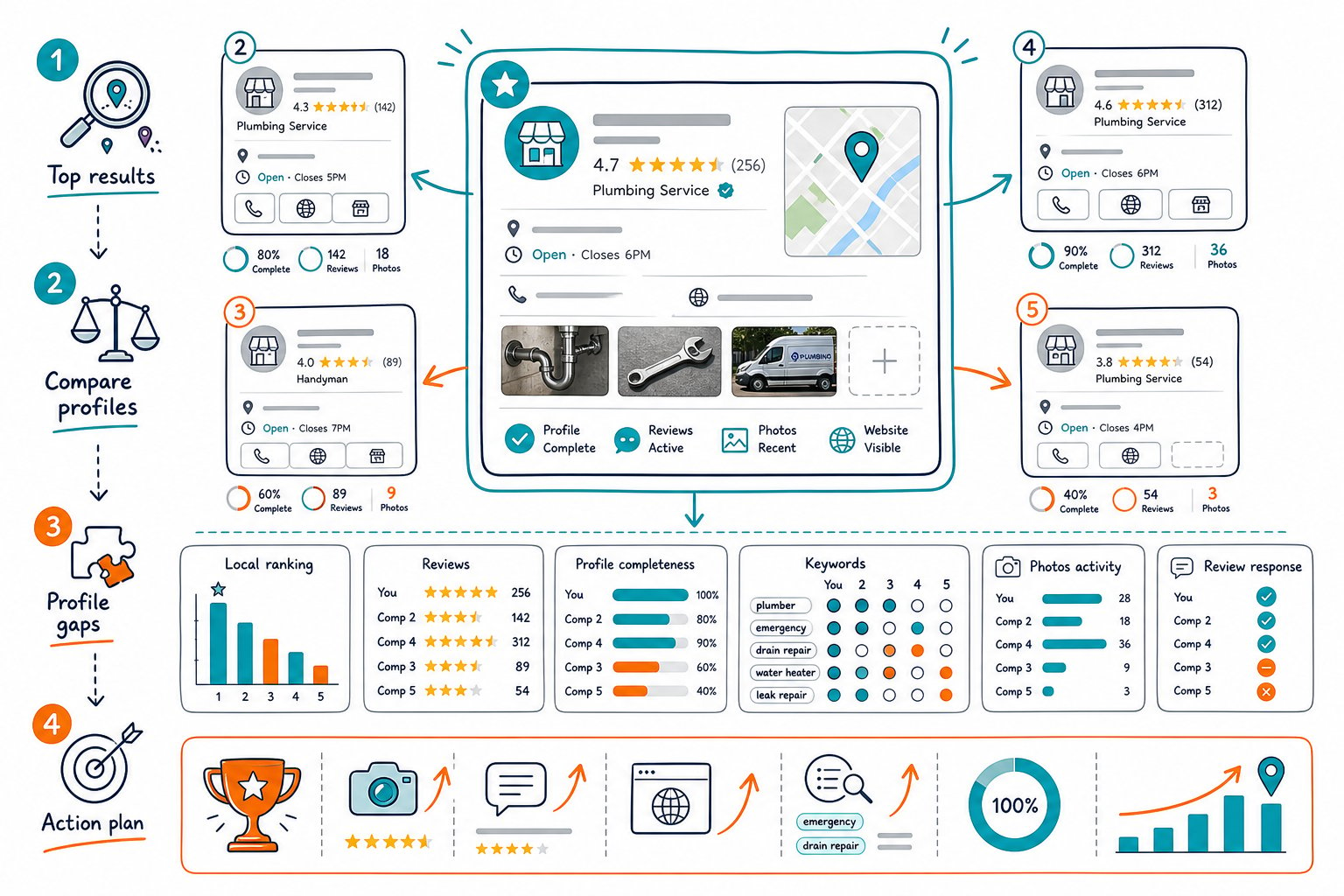
You can turn competitor findings into a focused local SEO backlog by tracking repeated competitors, recording visible profile gaps, and measuring the impact of each change. Your goal is to spot patterns among the businesses that keep showing up for your target searches, then apply the useful ones in a way that fits your own offer and customers.
How to Build a Useful Local Competitor Benchmark
Build a useful benchmark by comparing the same local competitors across the same searches and locations. Record profile data in one sheet, stick with consistent search terms, and separate direct business rivals from directory listings or brands outside your service area.
Choose Keywords, Search Locations, and Repeat Competitors
Start with commercial search queries your customers actually use, such as “emergency plumber in Austin” or “family dentist near Downtown Denver.” Search from each key service area because Local Pack results can change dramatically from one location to the next.
Keep a list of businesses that appear repeatedly in Google Search and Google Maps. A practical set includes four to six local competitors. Record each profile name, Knowledge ID or CID where available, ranking position, landing page, and search location.
Compare Categories, Services, and Attributes
Your primary category sends one of the strongest relevance signals in GBP. Compare it with competitors’ primary category choices, then document secondary categories and category combinations that keep recurring among top-ranking profiles.
Review listed services, service suggestions, attributes, and service area settings. A category finder can help you spot missing category options, though you should only select categories that accurately describe your business. Every chosen category should line up with real services and matching website copy.
Evaluate Reviews, Ratings, and Customer Sentiment
Track review count, ratings, recent review velocity, owner responses, and recurring themes in competitor reviews. You’ll often find a useful service angle hiding in customer language, such as same-day availability, clear pricing, bilingual support, or careful cleanup.
Use review analysis to classify sentiment by topic. If competitors receive repeated praise for a service you offer, add clear proof of that service to your GBP, landing page, and review request process. Don’t chase review count alone; review management also calls for timely, useful responses.
Assess Photos, Posts, Profile Completeness, and Landing Pages
Check photo freshness, image types, GBP posts, booking links, opening hours, and profile completeness. Competitor photos show what customers expect to see before calling, especially for restaurants, contractors, healthcare providers, and other location-based services.
Then review the landing page connected to each profile. Compare page intent, heading coverage, local proof, service detail, and calls to action. You can use competitor meta tags and heading checks to document page-level differences without relying on memory or a pile of screenshots.
Turn Competitor Gaps Into a Measurable Action Plan
GBP gaps are more likely to produce results when each finding has an owner, deadline, expected impact, and measurement method. Start with changes that improve relevance for profitable searches, then strengthen trust signals and track movement by location.
Your action plan should connect profile work with landing-page quality, review operations, post activity, and rank tracking. A local scan gives you the baseline, while repeated checks show whether your changes improved local visibility.
Prioritize Relevance, Prominence, and Trust Improvements
Score each task by business value, effort, and the gap visible across competitors. High-priority work includes correcting the primary category, adding valid services, improving incomplete attributes, strengthening location-page content, and responding to new reviews.
Use a Google Business Profile audit tool to capture profile findings alongside live page checks. Check Page SEO also extracts local SERP and Google Business Profile insights, including categories, service areas, review velocity, attributes, and booking links.
Use a Google Business Profile Audit Without Copying Competitors
A basic audit should reveal missing information and weak signals in your own profile. A review audit should identify response gaps and sentiment themes, while a post audit should assess whether your GBP posts support seasonal services, offers, or key customer questions.
Borrow coverage ideas, not competitor wording. If a rival highlights financing, emergency service, accessibility, or a niche specialty, verify that the detail applies to your business and explain it with your own proof. Use missing-topic checks for your content to improve your landing page with useful supporting sections.
Measure Local Visibility and Engagement Over Time
Track rankings for the same keywords, locations, and devices at regular intervals. Your measurement set should include Local Finder visibility, Map Pack visibility, calls, direction requests, website visits, and engagement metrics available through your GBP reporting.
Connect Google Search Console when you own the site to review landing-page clicks, impressions, CTR, average position, and ranking queries alongside your audit data. High impressions with weak CTR point to title, snippet, or intent issues, while weak local rankings across a service area point to relevance or prominence gaps.
Scale the Process for Agencies and Multi-Location Businesses
For multi-location businesses, create one benchmark template per location and keep competitor sets separate. A competitor in Phoenix may have little value in a Chicago review, even when both locations use the same brand and service list.
Agencies should standardize audit fields, assign tasks, and export client-ready reports. Tools such as GMB Everywhere and Yext support parts of GBP management, while AI GBP post generators, AI review response generators, AI GBP description generators, and AI Facebook post generators can speed up drafting, as long as you review every output for accuracy.
Use branded reports to show the baseline, completed actions, and changes in local visibility. When you are ready to audit live pages and local competitors in one workflow, download the Check Page SEO Chrome extension.