Optimising your web page content isn’t about jumping straight into rewriting. It all starts with figuring out what your audience wants, where your page already shines in search, and what tweaks could bump it up in Google’s results.
Good SEO is like a translator for your site. It helps real people and search engines both get what you’re saying, loud and clear.

If you start editing blindly, you might accidentally toss out stuff that’s already working. That’s why you need a solid audit plan to decide what’s worth keeping, what needs more love, and how you’ll measure success.
Diagnose The Page Before Editing
Kick things off by checking out the page’s current performance, the search intent behind your main keyword, and who you’re up against. Your mission? Find a real gap, not just cram in extra keywords or fluff.
Set The Page Goal And Search Intent
Pick one main goal for your page. Maybe you want leads, maybe you’re explaining something, maybe you’re selling, or maybe you’re just helping out existing customers.
Next, do a quick Google search for your main keyword. What kind of pages are at the top? Are they guides, product listings, deep dives, or something else entirely?
Your page has to match that vibe before you even worry about secondary keywords. No use being the odd one out.
Map out your secondary and long-tail keywords to sections that make sense. Tools like Semrush or Ubersuggest are handy for checking search volume, but don’t force keywords where they don’t belong.
Use Search Console To Prioritise Opportunities
Pop open Google Search Console and filter down to your exact URL. Compare the last 28 days to the previous stretch.
Look for queries with lots of impressions, rankings just off page one, and low click-through rates. That’s your low-hanging fruit.
If you spot a drop in clicks or impressions, try to link it to a specific date, a site change, or maybe a competitor’s move. A page with lots of impressions but no clicks probably needs a punchier title or a better opening answer.
If impressions are dropping, your content might need a refresh, more expertise, or stronger trust signals. Basically, don’t let your page get stale.
Check Keyword Overlap And Cannibalization
Type your main keyword into Google with site:yourdomain.com to see what pops up. If two pages go after the same query and solve the same problem, you’re splitting your own chances.
Only keep separate pages if they serve different purposes. For instance, a service page and a how-to guide can both exist, but if they’re basically twins, merge the best bits and redirect the weaker one.
Benchmark The Live URL And Competitor SERP
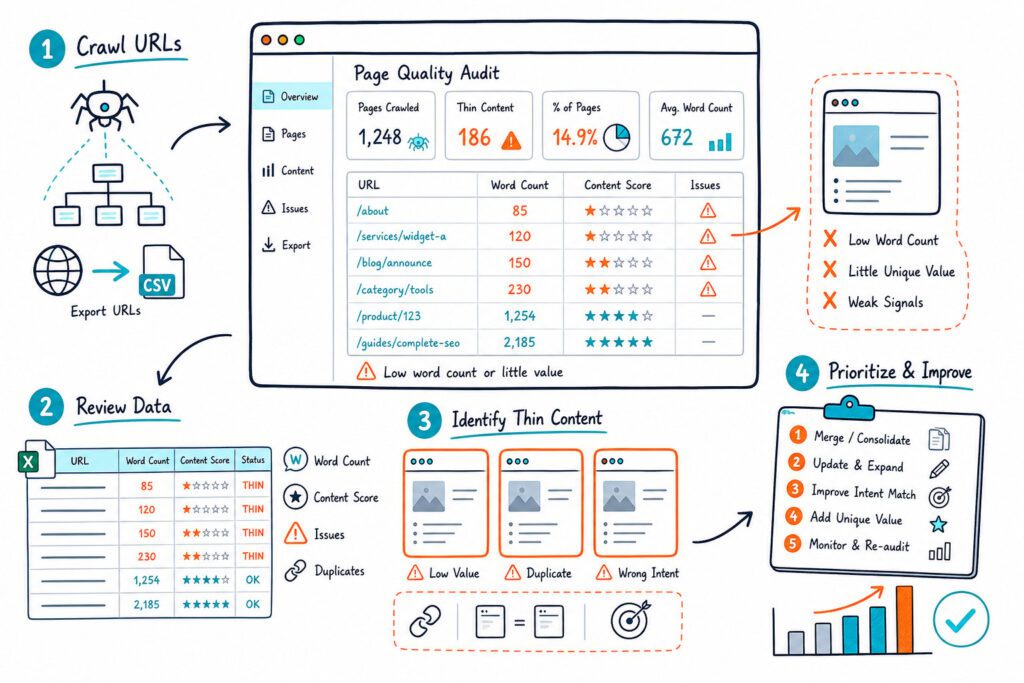
Before you touch a thing, jot down your current rankings, clicks, impressions, CTR, conversions, word count, page title, headings, internal links, and whether the page is actually indexed.
Always check the live URL, not just the preview in your CMS. A tool like Check Page SEO lets you see the real metadata, headings, links, images, and whether Google can index your page.
Scope out how competitors structure their pages and what topics they cover. Only add sections that genuinely help your reader. Google’s SEO Starter Guide says it best: make your page’s purpose obvious to both humans and search bots.
Apply, Validate, And Measure Page Improvements
Now for the fun part: make smart changes that boost relevance and user experience, but don’t mess up your technical SEO.
Keep a log of what you changed, when you published it, which URLs you touched, and what you expect to happen. A little nerdy, but super helpful.
Rebuild Titles, Descriptions, And Heading Structure
Craft a page title that matches the search and gives people a reason to click. Stick your main topic right up front, add a unique angle, and don’t repeat the same keyword across different titles.
Your meta description should actually preview what’s on the page, even though Google sometimes rewrites it. Use just one H1, then organize the rest with headings that answer real questions or guide the reader through tasks.
Clear headings help people skim and also let you double-check you’ve covered everything important.
Improve Copy Depth, Readability, And Entity Coverage
Beef up thin copy with examples, limitations, steps, product details, proof, and answers to common questions. Don’t just pad your word count to keep up with competitors.
Honestly, a shorter page can win if it nails the user’s intent fast.
Write in plain English. Keep paragraphs short, use lists, and label things clearly.
Sprinkle in relevant entities like brands, tools, locations, or product types where they help clarify. This makes your content richer for both people and search engines, without veering into keyword stuffing.
A regular review, like this guide on content optimisation, helps you stay on track with what your audience and Google expect.
Repair Links, Images, And Crawlability Signals
Check all your internal and external links for dead ends, bad redirects, or anchor text that’s too vague. Link to other pages with actual descriptive words, not just “click here”, because nobody likes a mystery.
Look at every image. Make sure each has useful alt text, not just for SEO but for accessibility too.
Ditch oversized files, make sure images actually load, and check that nothing important is being blocked or hidden by scripts, frames, or iframes.
Control URL Changes, Redirects, And Technical Delivery
Don’t change URLs just to make them prettier. A clean, hyphenated, lowercase URL is nice, but if your current one already has links and rankings, don’t mess with it unless you have to.
If you absolutely must change a URL, set up a one-to-one permanent redirect, update all the internal links, canonical tags, sitemaps, and navigation. Avoid redirect chains like the plague.
Check how your tech stack (JavaScript, PHP, WordPress, caching, CDN) affects the final page. Fast loading still matters. Yahoo!’s old-school web performance rules are still good reminders to keep your pages lean and mean.
Publish, Request Indexing, And Measure The Result
Once you hit publish, don’t just walk away. Check how the page looks in the wild on both desktop and mobile. Make sure the title tag, meta description, headings, canonical tags, robots directives, structured data, links, and all the important content show up just right.
After everything checks out, pop into Google Search Console and request indexing. Now, it’s time to watch the numbers roll in: keep an eye on clicks, impressions, CTR, average position, conversions, and how your queries shift over time.
Don’t panic if your low-traffic page doesn’t take off in a day or two. Patience, my friend. Keep a log of your tests so you’ll know if your wins came from new content, tech fixes, the season, or just Google shaking things up.
If you want a smoother ride, Add to Chrome for free and run an audit before every update. Trust me, your future self will thank you.