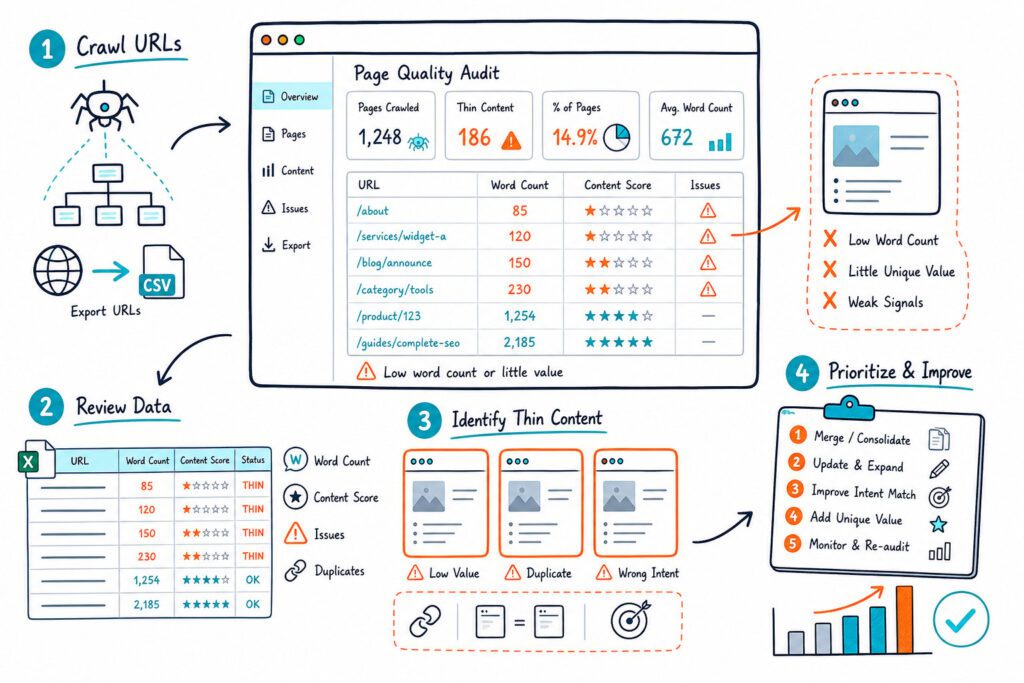
You find missing topics by comparing what your audience needs with what your pages actually answer. Start with your existing content, then test it against search intent, competitor coverage, search queries, and real customer questions.

A content gap isn’t always about a missing keyword. Sometimes you’ve got the topic, but you miss the mark on the right question, format, or detail that actually keeps people reading.
A good audit turns those weak spots into a focused content strategy that can bring in more organic traffic. And honestly, who doesn’t want that?
Build a Reliable Gap Inventory
Your inventory should show what you cover, what you only halfway cover, and what you’re completely missing. Separate page problems from site-wide topic gaps so you don’t end up creating duplicates and making a mess.
Separate Topic, Depth, Intent, Freshness, and Format Gaps
Label every gap before you do anything wild. That way, you won’t treat every missing keyword like it needs a whole new article.
- Topic gaps: You’re missing a relevant subject entirely.
- Depth gaps: You mention something but don’t explain it enough for anyone to care.
- Intent gaps: You’re aiming at the wrong need, like trying to rank a product page for a how-to search.
- Freshness gaps: Your info, prices, screenshots, or stats are ancient history.
- Format gaps: People want a checklist, calculator, or video, not a wall of text.
Ask yourself if the gap even matters to your business. More pages don’t magically make you an authority. Real expertise comes from useful, connected pages that actually help your audience and show off what you know.
Audit Existing Content Before Researching Competitors
Export your URLs from a site audit, your CMS, or Google Search Console. Group pages by topic cluster, target keyword, search intent, page type, impressions, clicks, and conversion value.
You might find your biggest gap isn’t missing content at all. Sometimes you’ve got three weak pages fighting for the same keyword, or your best guide is buried so deep no one can find it.
A handy content gap analysis workflow compares your stuff with competitors, but always start with your own house first.
For each URL, jot down:
- Primary and supporting topics
- Search intent and format
- Current keyword rankings and impressions
- Last real update
- Internal links pointing in
- Missing sections, examples, proof, or media
Compare Search Competitors and Their Content Coverage
Pop your target keyword into an incognito window and check out the pages that keep ranking, not just the big brands. Look for repeated headings, tools, examples, and page formats.
You’re hunting for patterns, not for stuff to copy-paste. If everyone else covers setup, cost, mistakes, and alternatives, and you only cover setup, you’ve got a gap.
Tools like Semrush, Ahrefs, and Moz can show you keywords your rivals rank for and you don’t. Treat their “gap analyzer” output as leads, not gospel. You still have to check the live pages to see if they actually fit your business.
Expand the List With People Also Ask and Audience Questions
Use People Also Ask, autocomplete, related searches, your own site search, sales calls, support tickets, reviews, and community chatter. That’s where you’ll hear how real people talk and what they actually want to know.
Check where users go after searching your site. As this guide to identifying content gaps from site-search behavior points out, search activity and visitor paths can reveal what you’re missing.
Add questions to your list only if you can answer them with real value. Sometimes a quick answer fits in an existing page. If it’s a big, hairy question with its own search results, give it its own page.
Use Page-Level Analysis to Find Missing Sections
A site audit finds big topic gaps. Page-level analysis digs up the missing sections that keep a good page from being a great answer.
Open your page next to a top competitor and compare their H1s, H2s, word count, semantic terms, images, internal links, schema, and readability. Check Page SEO lets you do this side by side, no need to mess with crawlers.
Pay close attention to heading gaps. If your competitor has a killer H2 that answers a clear sub-question, ask yourself if your readers need that too. Only add it if you can make it better with fresh examples, personal insight, or clearer steps.
Prioritize, Execute, and Validate Opportunities
Not every gap is worth filling. Your best bets are the ones with real demand, clear intent, business value, and a page you can actually make better than what’s already out there.
Score Opportunities by Demand, Difficulty, Intent, and Business Value
Set up a simple scoring model from 1 to 5 for each opportunity:
| Factor | What You Should Check |
|---|---|
| Demand | Search volume, impressions, and recurring audience questions |
| Difficulty | How tough the current search results are, links, brands, and content quality |
| Intent fit | Can your page actually satisfy what searchers want? |
| Business value | Revenue, lead quality, retention, or strategic importance |
| Effort | Research, writing, design, developer time, and approvals |
Don’t let search volume be the boss. Sometimes a low-volume keyword with buyer intent is worth way more than a broad term that brings in the wrong crowd.
For existing pages, if you see lots of impressions but weak clicks, that’s often a quicker win than starting from scratch.
Choose Between Updating, Consolidating, or Creating a New Page
Update an existing page if it already matches the search intent and has some traction. Add missing topics, sharpen headings, beef up examples, and fix anything outdated.
Consolidate when you’ve got a bunch of pages chasing the same goal. Keep the strongest one, merge in the good stuff, redirect the old ones, and fix your internal links.
Create a new page if the missing topic has a totally different intent, audience stage, or format. For example, a broad service page shouldn’t swallow a detailed troubleshooting guide just because they mention the same product.
Turn Prioritized Gaps Into a Topical Map and Content Calendar
Build a topical map around your main commercial pages. Put the big pillar pages at the center, then connect supporting guides, comparisons, FAQs, and case studies with clear internal links.
Your content calendar should include the target keyword, intent, assigned URL, page type, supporting topics, internal links, owner, and when you’ll measure results. This keeps your content plan from turning into a free-for-all.
Don’t forget to schedule refreshes. Content gets stale fast when competitors add better examples, products change, or search results start favoring newer formats.
Create Materially Better Coverage Instead of Copying Competitors
Competitor research shows you the bare minimum. Don’t let it become your outline.
Make your page stand out by adding things competitors can’t steal easily:
- Screenshots from your own process
- Clear decision rules and checklists
- Original data or tested examples
- Common risks and mistakes to avoid
- Product-specific steps and use cases
- Expert tips from your team or customers
Google looks at titles, headings, body content, links, and how happy users are. You boost your chances when your page answers the question fast, then gives enough detail so readers don’t bounce back to search. And really, that’s the name of the game.
Measure Rankings, Impressions, Clicks, and Cannibalization
Before you hit publish or update anything, take a snapshot of your current performance. Pop open Google Search Console, pick equal date ranges, and look at each page’s impressions, clicks, click-through rate, average position, and which queries are bringing in the traffic.
Once you’ve made your changes, give them time to work. The right timeframe depends on your site’s traffic. If you’re lucky enough to have high-traffic pages, you might spot changes in a few weeks. For quieter pages, grab a cup of patience and check back after a longer stretch.
Keep an eye out for cannibalization after publishing. If you notice two URLs swapping places for the same keyword, it’s time to get detective. Clarify each page’s intent, tighten up your internal links, and if things still look messy, combine the pages or redirect as needed.
If you want to make life easier, try Check Page SEO. It’ll help you audit those pages, compare their coverage, and turn your findings into a to-do list you can actually use.
Once you’ve got your action plan, Add to Chrome for free. You can audit live pages as you work, and spot anything you missed without breaking your flow.