Local search competitors are the businesses and pages fighting for attention when nearby customers search for your services. You can analyse local SERP competitors by tracking the live results for your target locations, separating Map Pack and organic rivals, then turning their visible strengths into specific local SEO tasks.
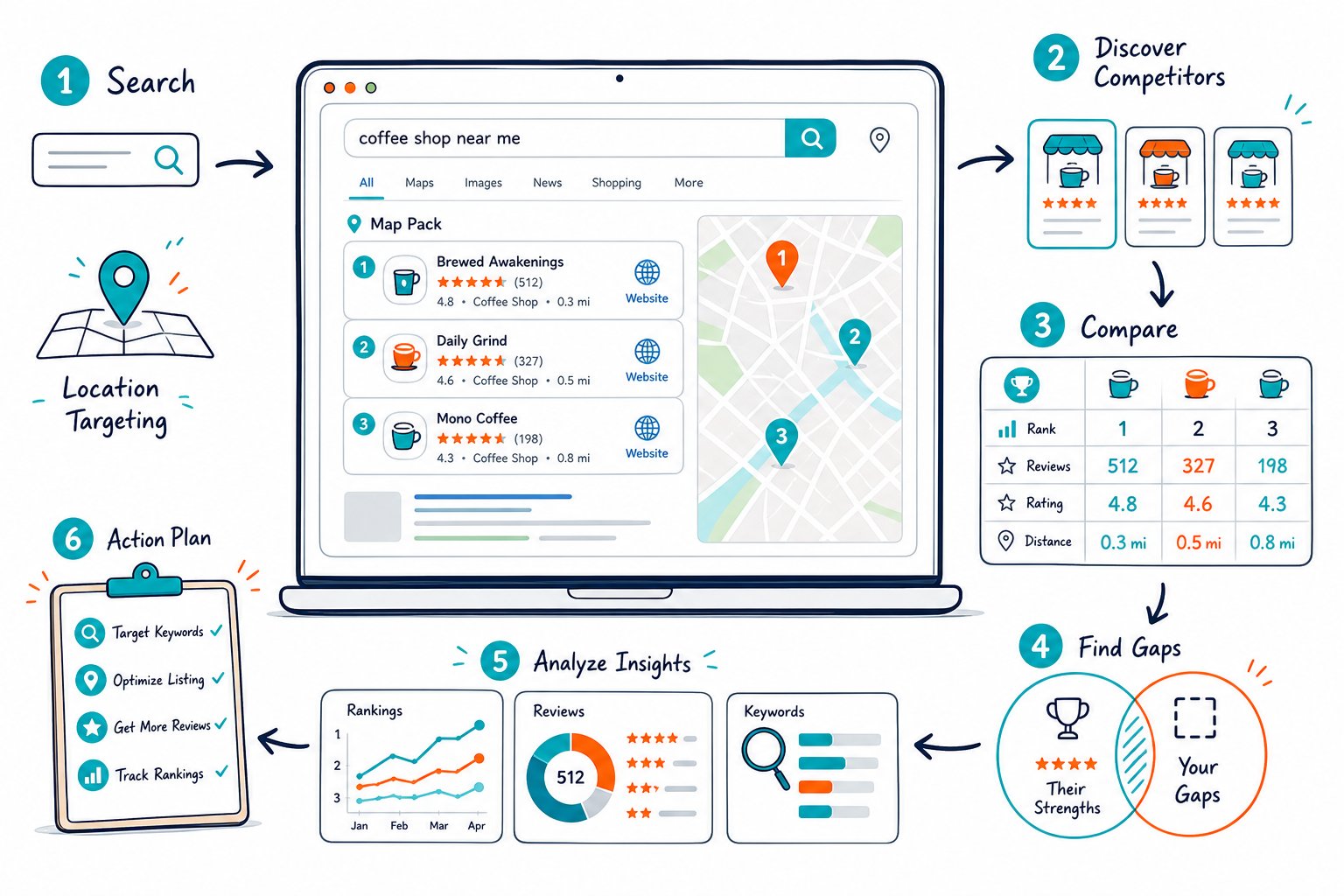
Your real competitors change by keyword, neighborhood, device, and user intent. A plumbing company might face local businesses in the Map Pack for “emergency plumber near me,” directories for “plumber reviews,” and editorial ranking pages for a broader service query. That’s how you analyse local SERP competitors without mixing up search visibility with business reputation.
Build a Reliable Local Competitor Baseline
Your baseline should capture the exact local search results customers see for each important service and location. Record the query, location, device, date, ranking URLs, Map Pack businesses, paid placements, and SERP features before judging competitors.
Define Local Keywords, Search Intent, and Service Areas
Start keyword research with your services, locations, and the language customers actually use. Include core local keywords such as “roof repair Denver,” long-tail keywords such as “flat roof leak repair in Capitol Hill,” and urgent queries such as “same day roof repair.”
Label each phrase by user intent: informational, comparison, booking, or emergency. A query containing “cost,” “reviews,” or “near me” can produce very different local search results, even when the service stays the same.
Build a simple sheet with:
- Keyword
- Service area or neighborhood
- Intent
- Desktop or mobile
- Search engine
- Current Map Pack and organic rankings
Capture Results by Location, Device, and Search Engine
Run searches from the city or service area you serve. Local packs can shift across a metro area, especially for service-area businesses and crowded markets. Check several ZIP codes or neighborhoods where you want to generate leads.
Record both mobile and desktop results. Mobile screens give the Map Pack, calls, directions, and reviews more above-the-fold space. Desktop results may show more organic ranking pages and image carousels.
Google drives most local SEO work, though Bing and Yahoo can still send leads in some markets. Keep their results in a separate tab so their ranking patterns don’t muddy your Google benchmark.
Separate Map Pack, Organic, Directory, and Paid Competitors
Tag every competitor by result type. Your Map Pack competitors are the businesses displayed with map listings. Your organic competitors are the pages ranking in the top 10 results. Directory competitors include Yelp, TripAdvisor, Angi, Solv, and niche local directories.
Paid search competitors deserve their own label. A Google Ad at the top of the search engine results page can absorb clicks even when your organic ranking improves.
You’ll often find that the same business doesn’t dominate every result type. That gap creates options: improve your Google Business Profile for local pack visibility, build a stronger local landing page for organic rankings, or fix a directory presence where customers do their research.
Record SERP Features and Above-the-Fold Visibility
SERP analysis needs more than positions. Note featured snippets, People Also Ask, AI Overviews, images, videos, knowledge panels, Things to Know, and image carousels. These features change the click opportunity for every ranking page.
Take screenshots of the initial viewport. A number-one organic result below ads, a local pack, and an AI Overview has less visible space than a number-four result on a clean SERP.
Use a live audit to inspect the ranking pages as you review them. You can check competitor meta tags and headings to capture title patterns, H1 topics, and structural gaps without copying each URL into a separate crawler.
Turn Competitor Findings Into Local SEO Priorities
Turn competitor evidence into a short task list ranked by impact, effort, and the page or profile it affects. Your priority list should connect a visible competitor advantage to a measurable fix on your Google Business Profile, local page, citations, or backlink profile.
Audit Google Business Profiles, Reviews, and Local Prominence
Compare each competitor’s Google Business Profile category, primary service, service areas, hours, booking links, attributes, photos, average rating, and review count. Record review velocity too. A profile gaining fresh reviews every month sends a different market signal from one with a high historic total and no recent activity.
Check NAP consistency across the profile, website, and major local directories. Name, address, and phone mismatches create avoidable friction for users and muddy entity clarity.
Read recent reviews for repeated service themes. When customers praise fast response times, clear pricing, or a specialist service, check whether your local content and profile describe that same proof point accurately.
Compare On-Page Content, Titles, and Conversion Signals
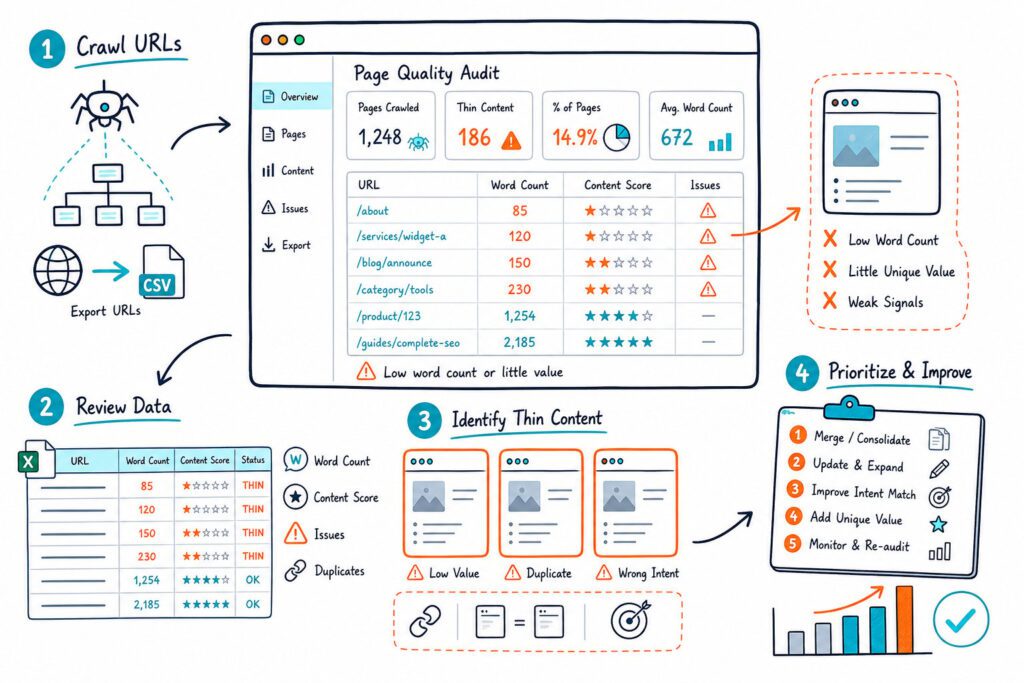
Audit the ranking pages for title tags, H1s, heading structure, word count, location coverage, internal links, schema, and conversion signals. Look for useful sections that answer real customer questions, such as pricing guidance, service process details, FAQs, project photos, or neighborhood coverage.
Don’t match a competitor’s word count just for the sake of it. Match the depth needed to satisfy the query. Use a website word count SEO review to compare meaningful visible content, then check whether your page offers clearer answers and stronger local proof.
Review readability as well. A service page packed with dense claims and repeated city names makes for a rough user experience. You can test content readability for SEO before publishing revised copy.
Assess Authority, Citations, and Backlink Gaps
Review competitor backlink profiles for relevant local links: chambers of commerce, local news, suppliers, trade groups, sponsorships, event pages, and community organizations. Focus on relevance and legitimacy before metrics such as Domain Authority, DR, UR, Moz, Ahrefs, or Semrush scores.
Use authority scores as comparison metrics, not ranking factors. A free domain authority checker can help you review available authority measurements, referring domains, backlinks, spam-risk indicators, and domain information for public competitor sites.
For citation gaps, list directories where several top competitors appear but your business doesn’t. Add only listings that are relevant to your market, and keep the same NAP format across every profile.
Create a Prioritized Content Brief and Measurement Plan
Create one content brief for each page you plan to improve. Include the target keyword, search intent, service area, required heading topics, local proof, conversion action, internal links, and competitor gaps worth closing.
Prioritize tasks in this order:
- Fix indexability, canonical, NAP, and Google Business Profile errors.
- Improve high-impression pages with weak local relevance or low CTR.
- Add missing service sections and local content found across ranking competitors.
- Build citations and relevant backlinks where evidence shows a clear gap.
- Track rankings, clicks, impressions, CTR, calls, form leads, and competitor movement.
Check performance in Google Search Console alongside the audited page. Compare equal date ranges, and leave out the most recent 72 hours from historical reporting because Google takes time to finalize the data.
Once you’ve gathered the findings, turn them into implementation instructions with an AI prompt for SEO recommendations. Then Download the Check Page SEO Chrome extension to review live local results, compare competitor pages, and export the task list your team needs.